On This Page
Harmed by Medical Negligence in Providence? Contact Us
Medical negligence and malpractice can cause serious complications and injuries, permanent disability, the need for corrective treatment, or wrongful death.
Determining whether medical professionals provided substandard care may require a detailed review of the medical records, applicable standard of care, expert opinions, and evidence connecting the error to the patient’s harm.
A Providence medical malpractice lawyer can investigate the treatment, identify potentially responsible providers and institutions, and pursue financial compensation for losses supported by the evidence.
Marasco & Nesselbush represents patients and families throughout Providence and Rhode Island and can explain the next steps in a medical malpractice claim.
Marasco & Nesselbush: Representing Rhode Islanders Since 1999
Medical negligence can leave a patient facing additional treatment, permanent disability, loss of income, reduced independence, or the death of a family member.
Errors involving a failure to diagnose, delayed diagnosis, surgical errors, medication mistakes, inadequate monitoring, or breakdowns in communication can turn an existing medical condition into a far more serious injury.
A poor medical outcome does not automatically mean that a doctor, nurse, hospital, or other provider committed medical malpractice.
A viable claim generally requires evidence that a doctor-patient relationship existed, the provider failed to meet the applicable standard of care, and the departure caused additional harm.
Medical records, diagnostic imaging, laboratory results, medication logs, hospital policies, electronic audit trails, and qualified expert opinions may all be needed to determine what occurred.
Hospitals, clinics, and medical practices may be independently responsible when failures involving credentialing, staffing, supervision, communication, or institutional procedures depart from applicable standards and cause patient harm.
Depending on the circumstances, liability may involve an individual physician, surgeon, nurse, pharmacist, medical group, hospital, or another healthcare organization.
Our attorneys investigate both individual treatment decisions and institutional failures involving staffing, communication, supervision, credentialing, and clinical procedures.
Since 1999, Marasco & Nesselbush has represented Rhode Island patients and families in complex medical malpractice and personal injury claims.
Our firm has a proven track record in cases involving catastrophic injuries, avoidable complications, and wrongful death, supported by detailed medical investigation and preparation for trial when necessary.
We investigate care received at Providence hospitals, emergency departments, surgical centers, clinics, specialist offices, and other facilities.
Our bilingual team communicates with clients in English or Spanish from the initial consultation through negotiations, litigation, and resolution.
Marasco & Nesselbush offers a free consultation to patients and families who suspect negligent medical care caused additional harm.
We handle qualifying medical malpractice cases on a contingency fee basis, meaning clients pay no attorney fees unless the firm obtains a recovery.
Why Providence Medical Malpractice Victims Choose Marasco & Nesselbush
Medical malpractice cases require more than evidence that a patient experienced a poor result.
A successful claim often depends on proving the applicable standard of care, identifying the specific act or omission that departed from it, and establishing through qualified medical testimony that the error caused a severe injury or death.
Our medical malpractice attorneys conduct a thorough investigation, work with appropriate medical experts, and prepare each case to pursue a favorable outcome supported by the evidence and Rhode Island law.
Clients choose Marasco & Nesselbush for:
- Detailed medical-record review: We collect and analyze hospital records, physician notes, diagnostic imaging, laboratory results, medication records, nursing documentation, consent forms, and other materials needed to understand the patient’s treatment.
- Qualified medical experts: Our law firm consults medical experts who can evaluate the applicable standard of care, determine whether a provider departed from it, and explain how the departure caused additional harm.
- Preservation of crucial evidence: Electronic health-record audit trails, internal communications, staffing records, hospital policies, imaging files, and other evidence may be difficult to obtain or preserve without prompt legal action.
- Analysis of individual and institutional liability: Responsibility may extend beyond an individual doctor or nurse to a hospital, clinic, medical group, pharmacy, or other healthcare organization whose policies, staffing, supervision, or communication failures contributed to the injury.
- Experience with complex medical claims: Our attorneys handle cases involving failure to diagnose, delayed treatment, surgical errors, medication mistakes, inadequate monitoring, birth injuries, hospital negligence, and wrongful death.
- Careful causation analysis: A provider’s mistake must be connected to the patient’s injury through competent medical evidence. We examine whether earlier diagnosis, proper treatment, closer monitoring, or a different procedure probably would have prevented or reduced the harm.
- Documentation of long-term losses: Serious medical injuries may require corrective procedures, rehabilitation, home care, assistive equipment, and continuing treatment. We work to document medical expenses, lost income, reduced earning capacity, disability, pain, and the effect of the injury on daily life.
- Preparation for negotiation and trial: Meaningful settlement discussions depend on a well-supported claim. We prepare the medical evidence, expert opinions, damages documentation, and legal arguments necessary to litigate the case when liability or fair compensation remains disputed.
- Clear and responsive legal services: We explain the medical and legal issues, provide updates as the case develops, and help clients understand the decisions that may affect their claim.
- English- and Spanish-language support: Our bilingual team communicates with clients in English or Spanish from the initial consultation through negotiations, litigation, and resolution.
Marasco & Nesselbush has represented injured Rhode Islanders since 1999.
Our 18 attorneys bring more than 350 years of combined experience, and the firm has recovered more than $500 million for clients across its personal injury practice.
With offices in Providence, East Providence, Warwick, Wakefield, and Woonsocket, we provide local access to patients and families throughout Rhode Island.
Our Providence Medical Malpractice Lawyers Get Results
Marasco & Nesselbush has obtained substantial verdicts and settlements for patients and families harmed by medical negligence.
Our results include cases involving delayed treatment, surgical errors, negligent monitoring, anesthesia mistakes, avoidable amputations, permanent disability, and wrongful death.
Each recovery reflects the medical evidence, expert testimony, causation issues, damages, defendants, and applicable law involved in that specific case.
Past results do not guarantee or predict the outcome of another medical malpractice claim.
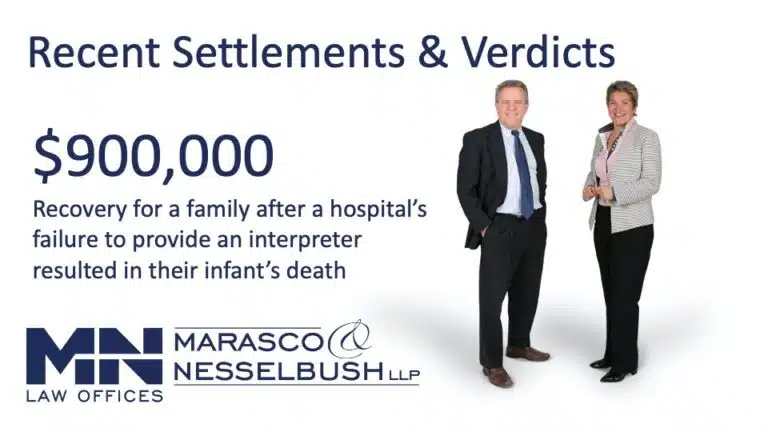
Examples of medical malpractice results obtained by our attorneys include:
- $9 million secured for a client who suffered life-altering complications due to medical negligence during and after a standard procedure.
- $8.49 million secured for a client who suffered an avoidable amputation due to medical negligence during knee-replacement surgery.
- $7.27 million jury verdict for a client who suffered life-altering injuries after medical providers failed to timely treat a stroke.
- $3 million recovered for the family of an infant who died as a result of medical negligence.
- $3 million awarded to the family of an infant who died after a delay in medical treatment.
- $3 million settlement for a client who sustained permanent disabling injuries after negligent neck surgery.
- $2.05 million recovered for the family of a man who died because of negligent anesthesia administration.
- $2 million awarded to the family of a woman who died because of negligent monitoring at a local hospital.
- $1.5 million secured for a family after a hospital was found liable for a wrongful death involving an undiagnosed brain injury.
- $1 million settlement obtained after a five-year legal case for a cancer survivor harmed by medical negligence.
What Is Medical Malpractice in Rhode Island?
Medical malpractice occurs when a doctor, hospital, or other healthcare provider fails to use the level of care and skill expected of a reasonably competent provider in the same professional field under the same or similar circumstances.
A poor outcome, known complication, or unsuccessful treatment does not by itself establish that malpractice occurred.
A patient generally must prove that the provider departed from accepted medical standards and that the departure caused additional injury or loss.
The analysis may involve the patient’s condition, the information available to the provider, the treatment performed, and the medical resources available at the time.
Qualified medical experts are usually needed to determine whether malpractice occurred, explain the applicable standard of care, and connect the provider’s conduct to the patient’s harm.
Expert testimony may not be necessary when the error is so apparent that an ordinary person could recognize the lack of reasonable care without specialized medical knowledge.
A Bad Medical Outcome Does Not Automatically Mean Malpractice
A patient may experience serious complications even when a doctor, nurse, or other provider acted reasonably under the circumstances.
Proving malpractice requires more than showing that an injury occurred after treatment in a hospital, clinic, or emergency room.
The medical staff may have made a reasonable decision based on the patient history, symptoms, test results, and information available at the time.
A viable claim generally requires evidence that the provider departed from the accepted standard of care and that the departure caused additional harm.
Medical records and qualified expert opinions are usually needed to distinguish an unavoidable complication or reasonable medical judgment from negligent care.
Types of Medical Malpractice and How They Occur
Medical malpractice can occur during diagnosis, treatment, surgery, medication management, monitoring, or communication among members of the medical community.
Diagnostic errors may prevent a patient from receiving a timely diagnosis and allow an illness or injury to progress without appropriate treatment.
A delayed diagnosis occurs when a doctor fails to identify a condition within a reasonable time, despite symptoms, test results, or other information that should have prompted further evaluation.
Other errors may occur during a surgical procedure, medication administration, or follow-up care and expose patients to serious risks that proper medical practice could have reduced.
Common types of medical malpractice include:
- Failure to diagnose: A provider may overlook symptoms, fail to order appropriate tests, misread results, or dismiss signs of a serious medical condition.
- Delayed diagnosis: Treatment may be postponed when a doctor fails to recognize a condition promptly, refer the patient to a specialist, or respond to abnormal findings.
- Surgical errors: A surgeon or medical team may damage an organ, leave an object inside the patient, perform the wrong procedure, or fail to manage complications during or after surgery.
- Wrong-site surgery: A surgical team may operate on the wrong body part, wrong side, or wrong patient because of identification, documentation, or communication failures.
- Medication errors: Providers may prescribe, dispense, or administer the wrong drug or dosage, overlook an allergy, or fail to account for harmful drug interactions.
- Anesthesia errors: Improper dosing, inadequate monitoring, or failure to review the patient’s medical history may cause brain injury, organ damage, or death.
- Failure to monitor: Doctors, nurses, or hospital staff may fail to recognize worsening vital signs, infection, internal bleeding, fetal distress, or another developing emergency.
- Birth and obstetrical injuries: Errors during pregnancy, labor, or delivery may involve failure to respond to fetal distress, delayed delivery, improper use of instruments, or inadequate treatment of maternal complications.
- Inadequate follow-up care: A provider may fail to communicate test results, arrange additional testing, monitor recovery, or respond when a patient reports worsening symptoms.
- Lack of informed consent: A provider may perform treatment without adequately explaining known material risks and viable alternatives to the proposed treatment.
Who May Be Held Responsible for Medical Malpractice in Rhode Island?
Responsibility for medical malpractice may extend beyond the individual provider who made the treatment decision or performed the procedure.
A claim may involve several people or organizations when failures in diagnosis, treatment, communication, supervision, or institutional procedures contributed to the patient’s injury.
Liability depends on each party’s role, the applicable standard of care, and whether the negligent conduct caused additional harm. Rhode Island law recognizes a broad range of licensed healthcare providers and facilities that may participate in a patient’s diagnosis and treatment.
The parties that may be held responsible include:
- Physicians, surgeons, and specialists: A doctor may be liable for diagnostic errors, delayed treatment, surgical mistakes, inadequate monitoring, improper follow-up care, or another departure from accepted medical practice.
- Nurses and other clinical staff: Nurses, physician assistants, technicians, and other staff members may be responsible for medication errors, failures to monitor the patient, communication breakdowns, or delays in responding to a medical emergency.
- Hospitals and medical facilities: A hospital or clinic may be liable for negligence by its employees or agents. A facility may also bear responsibility for its own failures involving credentialing, staffing, supervision, patient-safety procedures, or communication systems.
- Medical groups and professional practices: A physician’s employer or medical practice may share responsibility when the negligent provider was acting within the scope of employment.
- Pharmacists and pharmacies: Medication-related claims may involve dispensing the wrong drug or dosage, failing to identify a harmful interaction, or providing incorrect instructions.
- Diagnostic laboratories and imaging facilities: A laboratory, radiologist, pathologist, or imaging center may be responsible for improperly performed tests, misinterpreted results, or failures to report significant findings.
- Independent contractors and apparent agents: A hospital is not automatically responsible for every independent physician who provides treatment at the facility. Liability may still exist when the evidence establishes an employment or agency relationship, including circumstances in which the hospital presented the provider as its agent and the patient reasonably relied on that representation.
More than one defendant may share responsibility for the same injury, particularly when a patient received care from several providers or departments.
Employment contracts, credentialing documents, medical records, hospital policies, and communications among providers may help establish each party’s role.
Our attorneys investigate the complete course of treatment to identify the individuals and organizations whose conduct may support a medical malpractice claim.
Injured and not sure what your case is worth? Find out for free.
What Must Be Proven in a Rhode Island Medical Malpractice Case?
A medical malpractice claim must be supported by evidence establishing each part of the provider’s legal responsibility for the patient’s harm.
The analysis begins with the treatment relationship and then examines the provider’s conduct, the medical cause of the injury, and the resulting losses.
Records from a primary care physician, specialist, hospital, or other provider may show what information was available and which decisions were made.
Qualified experts can compare the care provided with accepted medical practice and explain whether a different course of treatment probably would have prevented or reduced the injury.
A legal team must also document how the injury affected the patient’s health, employment, finances, and daily life.
To pursue compensation, injured patients generally must prove the following elements:
- A Healthcare Provider Owed the Patient a Duty of Care: A professional duty generally arises when the provider accepts responsibility for evaluating, diagnosing, or treating the patient.
- The Provider Departed From the Accepted Standard of Care: The evidence must show that the provider’s conduct fell below the care and skill expected of a reasonably competent practitioner under similar circumstances.
- The Medical Error Caused Additional Harm: The patient must establish a causal connection between the provider’s departure from the standard of care and the injury being claimed.
- The Patient Sustained Compensable Losses: The error must have resulted in actual harm, such as additional medical treatment, lost income, disability, pain, or other measurable losses.
Failure to prove any one of the required elements can prevent recovery.
When medical causation depends on expert testimony, Rhode Island courts generally require evidence expressed in terms of probability rather than mere possibility.
A legal team can collect the medical records, consult qualified experts, document the patient’s losses, and determine whether the available evidence supports each element.
When the evidence establishes duty, breach, causation, and damages, the patient may pursue compensation from the responsible providers or healthcare institutions.
Why Medical Experts Are Important to a Malpractice Claim in Rhode Island
Medical experts are usually needed because the standard of care, treatment decisions, and medical causation often involve issues outside an ordinary juror’s knowledge.
Rhode Island permits expert testimony from people qualified by knowledge, skill, experience, training, or education in the field of the alleged malpractice.
An expert can review the records, identify whether the provider departed from accepted medical practice, and explain how appropriate care would have differed.
Expert testimony may also be required to establish that the provider’s error probably caused the patient’s additional injury rather than merely creating a possible connection.
What Should You Do if You Suspect Medical Malpractice?
Suspected medical negligence can leave a patient uncertain about what happened, whether additional treatment is needed, and how the injury may affect the family’s future.
The immediate priority should be obtaining appropriate health care from a qualified provider, especially when symptoms are worsening or urgent.
Patients should also request complete medical and billing records, which generally may be accessed under the HIPAA Privacy Rule.
Time is important because Rhode Island generally requires medical malpractice actions to be filed within three years of the incident, subject to specific statutory exceptions.
Taking organized steps early can protect the legal process and help document the medical costs, physical harm, and emotional toll caused by the suspected error.
Steps to take after suspected medical malpractice include:
- Seek necessary medical treatment: Obtain emergency care, corrective treatment, or an independent medical evaluation when needed, and follow the new provider’s instructions.
- Request complete medical and billing records: Ask for physician notes, hospital records, imaging, laboratory results, medication records, consent forms, discharge instructions, and itemized bills.
- Create a detailed timeline: Record appointments, symptoms, diagnoses, procedures, conversations, test results, and changes in your condition while the events remain fresh.
- Preserve relevant materials: Keep medication containers, written instructions, patient-portal messages, photographs, medical devices, receipts, and correspondence from providers or insurers.
- Identify all involved providers: List the doctors, nurses, specialists, hospitals, clinics, pharmacies, and other parties involved in the care.
- Document the effects of the injury: Maintain records of additional treatment, missed work, out-of-pocket expenses, physical limitations, and changes in daily activities.
- Avoid altering original records: Keep original documents intact and make separate notes when recording questions or possible inaccuracies.
- Seek legal representation promptly: A lawyer can evaluate filing deadlines, obtain records, consult medical experts, and determine whether the evidence supports a malpractice claim.
Medical malpractice cases often require a detailed review before anyone can determine whether the care fell below accepted standards and caused additional harm.
A legal team can investigate the treatment, preserve evidence, identify responsible providers, and calculate losses related to medical costs, income, disability, and future care.
Prompt legal representation also allows the patient and family to understand their options before critical evidence is lost or a filing deadline expires.
Rhode Island Medical Malpractice Laws
Rhode Island law acknowledges that medical malpractice claims require proof that a healthcare provider failed to meet the applicable professional standard and caused a patient harm.
The claimant generally must establish a duty of care, a departure from accepted medical practice, medical causation, and compensable losses.
Under Rhode Island Supreme Court precedent, physicians are measured against the care and skill expected of reasonably competent practitioners in the same professional class acting under the same or similar circumstances.
Qualified expert testimony is usually needed to explain the standard of care and causation unless the alleged negligence is apparent without specialized medical knowledge.
The statute of limitations generally requires a medical malpractice action to be filed within three years of the incident that gave rise to the claim.
Important Rhode Island laws that affect medical malpractice claims include:
- Limitation on malpractice actions (R.I. Gen. Laws § 9-1-14.1): A medical malpractice lawsuit generally must be filed within three years of the incident that gave rise to the claim. When the resulting injury or damages could not have been discovered through reasonable diligence at the time, the discovery rule may allow filing within three years from when the malpractice should have been discovered. The statute also contains separate provisions for minors and people with certain qualifying disabilities.
- Expert witnesses in malpractice cases (R.I. Gen. Laws § 9-19-41): A person may testify as an expert about alleged malpractice only when qualified by knowledge, skill, experience, training, or education in the relevant field.
- Informed consent as a preliminary question (R.I. Gen. Laws § 9-19-32): The court initially considers issues involving informed consent and the reasonable disclosure of known material risks as preliminary questions of fact. The issue is submitted to the jury only when the court determines that reasonable minds could reach different conclusions based on the evidence.
- Res ipsa loquitur in medical malpractice actions (R.I. Gen. Laws § 9-19-33): The court initially decides whether the circumstances support a reasonable inference of negligence without direct proof identifying the precise medical error.
- Collateral-source rule in medical malpractice actions (R.I. Gen. Laws § 9-19-34.1): A defendant may elect to introduce evidence of certain insurance, disability, workers’ compensation, or healthcare benefits payable to the patient. When the statute applies, the damages award may be reduced by the qualifying benefits received after accounting for amounts the patient paid to obtain them.
The rules that apply depend on the type of treatment, the defendants involved, when the malpractice should reasonably have been discovered, and the patient’s age or legal capacity.
Requesting medical records, filing a complaint with the hospital, or discussing the claim with an insurer does not automatically extend the filing deadline.
A Providence medical malpractice lawyer can review the treatment dates, potential exceptions, expert evidence, and applicable requirements before the statute of limitations expires.
Do You Qualify for a Medical Malpractice Lawsuit?
You may qualify for a Rhode Island medical malpractice lawsuit if a healthcare provider owed you a duty of care, departed from the accepted professional standard, and caused you additional harm.
A poor medical outcome, known complication, or unsuccessful treatment does not alone establish malpractice.
A claim may be supported by evidence involving a diagnostic delay, surgical error, medication mistake, failure to monitor, inadequate follow-up care, or another preventable departure from accepted practice.
Qualified medical experts are usually needed to compare the treatment provided with the applicable standard of care and explain whether the provider’s conduct probably caused the injury.
The patient must also have compensable losses, such as additional medical treatment, lost income, disability, pain, or the death of a family member.
Because Rhode Island generally imposes a three-year filing period with limited exceptions, a suspected claim should be reviewed promptly based on the medical records, treatment dates, and circumstances of the injury.
Evidence in a Medical Malpractice Claim
Medical malpractice claims depend on evidence showing what care was provided, how the provider departed from accepted medical practice, and how the error caused additional harm.
Medical records and expert opinions are often necessary to distinguish negligence from a known complication or unavoidable outcome.
Evidence is also needed to document the patient’s physical limitations, lost income, future care needs, and expensive medical bills.
Collecting the relevant materials early can help preserve important information and allow the claim to be evaluated before records become difficult to obtain.
Evidence used in a medical malpractice claim may include:
- Medical records: Physician notes, hospital charts, nursing records, operative reports, discharge instructions, and treatment plans can establish what care was provided.
- Diagnostic imaging and laboratory results: X-rays, CT scans, MRIs, pathology reports, blood tests, and other results may show when a condition should have been identified or treated.
- Electronic health record audit trails: Audit data may identify when records were created, accessed, changed, or reviewed by members of the medical staff.
- Medication records: Prescriptions, pharmacy records, medication administration logs, and allergy information may help establish a medication error or dangerous interaction.
- Consent forms and patient instructions: Written materials may show what procedure was authorized, which risks were disclosed, and what follow-up care was recommended.
- Hospital policies and clinical protocols: Internal procedures may help determine whether staff followed established safety, monitoring, communication, and treatment requirements.
- Communications among providers: Emails, patient portal messages, referral records, consultation notes, and handoff documentation may reveal delays or failures in communication.
- Qualified medical expert opinions: Experts can explain the applicable standard of care, identify departures from accepted practice, and connect the provider’s conduct to the patient’s injury.
- Medical bills and insurance statements: Billing records can document the cost of corrective treatment, rehabilitation, medication, and continuing care.
- Employment and income records: Pay stubs, tax documents, employer statements, and vocational evaluations may support claims for lost wages or reduced earning capacity.
- Photographs, videos, and personal records: Images of injuries, symptom journals, calendars, and statements from family members may document changes in the patient’s health and daily life.
- Future-care evaluations: Life-care plans, rehabilitation assessments, and medical projections may establish the cost of ongoing treatment, assistance, equipment, or home modifications.
Potential Compensation in a Providence Medical Malpractice Case
Damages are the financial and personal losses attributed to the additional harm caused by medical negligence.
Economic damages are calculated using medical bills, employment records, receipts, and other evidence showing the patient’s past expenses and lost income.
Future losses may require testimony from physicians, vocational specialists, economists, or life-care planners to estimate future medical expenses, reduced earning capacity, and long-term support needs.
Non-economic damages address consequences that do not have a fixed price, including pain and suffering, emotional distress, disability, and loss of enjoyment of life.
Rhode Island generally does not impose a statutory cap on damages in private medical malpractice cases, and state law permits wrongful death damages when malpractice causes a patient’s death.
Compensation in a successful medical malpractice case may include:
- Past medical expenses: The cost of hospitalization, corrective procedures, medication, rehabilitation, therapy, and other care required because of the injury.
- Future medical expenses: The expected cost of additional treatment, surgeries, medication, rehabilitation, medical equipment, home modifications, and personal assistance.
- Lost wages: Income and employment benefits lost while the patient was unable to work or attend necessary appointments.
- Reduced earning capacity: Compensation for a lasting injury that limits the patient’s ability to work or earn income in the future.
- Pain and suffering: Compensation for physical pain, chronic symptoms, discomfort, and the overall severity and duration of the injury.
- Emotional distress: Compensation for anxiety, depression, trauma, fear, sleep disruption, and other psychological effects caused by the injury.
- Disability and disfigurement: Compensation for paralysis, amputation, scarring, loss of mobility, or another permanent change in physical function or appearance.
- Loss of enjoyment of life: Compensation for the reduced ability to participate in hobbies, family activities, exercise, travel, and other meaningful parts of daily life.
- Loss of consortium: Compensation that may be available to a spouse for the loss of companionship, affection, assistance, and marital relations.
- Wrongful death damages: Compensation may include statutory pecuniary losses, loss of consortium or family relationships, and other estate or beneficiary damages permitted by Rhode Island law.
How Marasco & Nesselbush Investigates Medical Malpractice
Marasco & Nesselbush begins by collecting the patient’s complete medical records, billing documents, diagnostic studies, prescriptions, and communications with healthcare providers.
Our attorneys organize the treatment history into a detailed chronology to identify when symptoms appeared, what information was available, and how the medical team responded.
We then consult qualified medical experts who can evaluate the applicable standard of care and determine whether a provider’s actions or omissions departed from accepted practice.
The investigation also examines whether individual providers, hospitals, medical groups, pharmacies, or other institutions may share responsibility for the injury.
Our legal team analyzes medical causation to determine whether proper diagnosis, treatment, monitoring, or follow-up probably would have prevented or reduced the patient’s harm.
We document the resulting losses through medical bills, employment records, future-care assessments, and evidence showing how the injury has affected the patient’s health and daily life.
Each claim is prepared for meaningful settlement negotiations and, when necessary, litigation and trial.
How Much Does It Cost to Hire a Medical Malpractice Lawyer from Our Firm?
Marasco & Nesselbush offers a free initial consultation to patients and families considering a medical malpractice claim.
We handle qualifying cases on a contingency fee basis, meaning clients do not pay attorney fees unless the firm obtains a recovery.
Medical malpractice cases may also involve expenses for medical records, expert review, depositions, court filings, and other litigation costs.
Responsibility for those expenses and the percentage charged as an attorney fee are explained in the written representation agreement.
Our attorneys review the fee arrangement before representation begins so clients understand how costs will be handled.
Marasco & Nesselbush: Talk to a Providence Medical Malpractice Lawyer
Medical negligence can leave a patient facing additional treatment, permanent disability, lost income, and uncertainty about how the injury will affect the future.
Marasco & Nesselbush represents patients and families in claims involving diagnostic errors, surgical mistakes, inadequate monitoring, medication errors, hospital negligence, and wrongful death.
Our attorneys can collect the medical records, consult qualified experts, determine which providers or institutions may be responsible, and document the full extent of the resulting losses.
As experienced trial lawyers, we prepare each claim for litigation when the evidence supports legal action and a fair resolution cannot be reached through negotiation.
Our bilingual team communicates with clients in English or Spanish throughout the representation. Contact Marasco & Nesselbush for a free consultation with a Providence medical malpractice lawyer.
If you or a loved one suffered serious harm because of suspected medical negligence, contact Marasco & Nesselbush to discuss your legal options with a Providence medical malpractice lawyer.
You can also use the chat feature on this page to get in touch with our experienced medical malpractice attorneys.
Talk to a lawyer and get a free case evaluation today.